
Everything Looks Fine Until You Try to Predict Receptors
Receptors transmit signaling inputs across the body, determining how cells respond to hormones, neurotransmitters, odorants, and drugs, and are therefore often described as sensors. Not wrong, but about as precise as calling a compiler a text parser. Their real function is to take messy molecular inputs and commit the cell to a specific downstream decision, under competition, noise, and incomplete information. From that perspective, receptors are less interesting for whether they bind a ligand than for which interactions are worth propagating, for how long, and in what context. They integrate timing, relative affinity, and molecular competition, discard most of what they encounter, and pass along a signal that looks deceptively simple.
Over the past two decades, biotech and experimental biology have focused heavily on receptor systems, treating them as intrinsic sensors for probing and modulating cellular signaling. This perspective underlies much of modern drug discovery and the broader ambition of making biological behavior "programmable". It has produced an extensive and sophisticated mechanistic literature. And yet receptor systems can feel simultaneously well understood and frustratingly hard to predict.
But why aren't receptors predictable (and programmable)? Most experimental workflows and receptor assays today approach receptor mechanisms as a problem of activation rather than resolution. Much like taking a snapshot of the result at the end and collapsing rich behavior into a small number of summary statistics. Most industry-standard assays reduce signaling to dose–response curves, EC50s, and maximal activity, capturing whether signaling occurs but not how it is negotiated under competition, concentration, or time. As a result, ligands that differ in interaction lifetimes, competitive behavior, or context sensitivity can appear equivalent. We've come to think of this failure mode as signal amnesia. By the time an effect is measured, the receptor has already resolved competing inputs, committed to a signaling state, and discarded intermediate information. What remains observable is the outcome, not the decision that produced it.
One of the more counterintuitive aspects of this problem is the role of space. Signaling is not uniform across the cell. The same receptor can produce meaningfully different outcomes depending on whether it signals from the plasma membrane or from internalized compartments, because it encounters different partner concentrations, scaffolds, and kinetic constraints. Time introduces a similar distortion. In standard assays, transient and sustained signaling are frequently conflated, even though they encode different biological consequences. When measurements integrate over time without resolving sequence or duration, ligands with different decision logic can end up looking the same.
G protein–coupled receptors (GPCRs) are where this mismatch becomes most apparent. They are among the most heavily studied proteins in biology, yet ligands that appear equivalent by standard assays routinely diverge under competition, altered dosing, or physiological context. The mechanisms are well described; the resolution step that distinguishes ligands is simply not captured by the measurements we rely on.
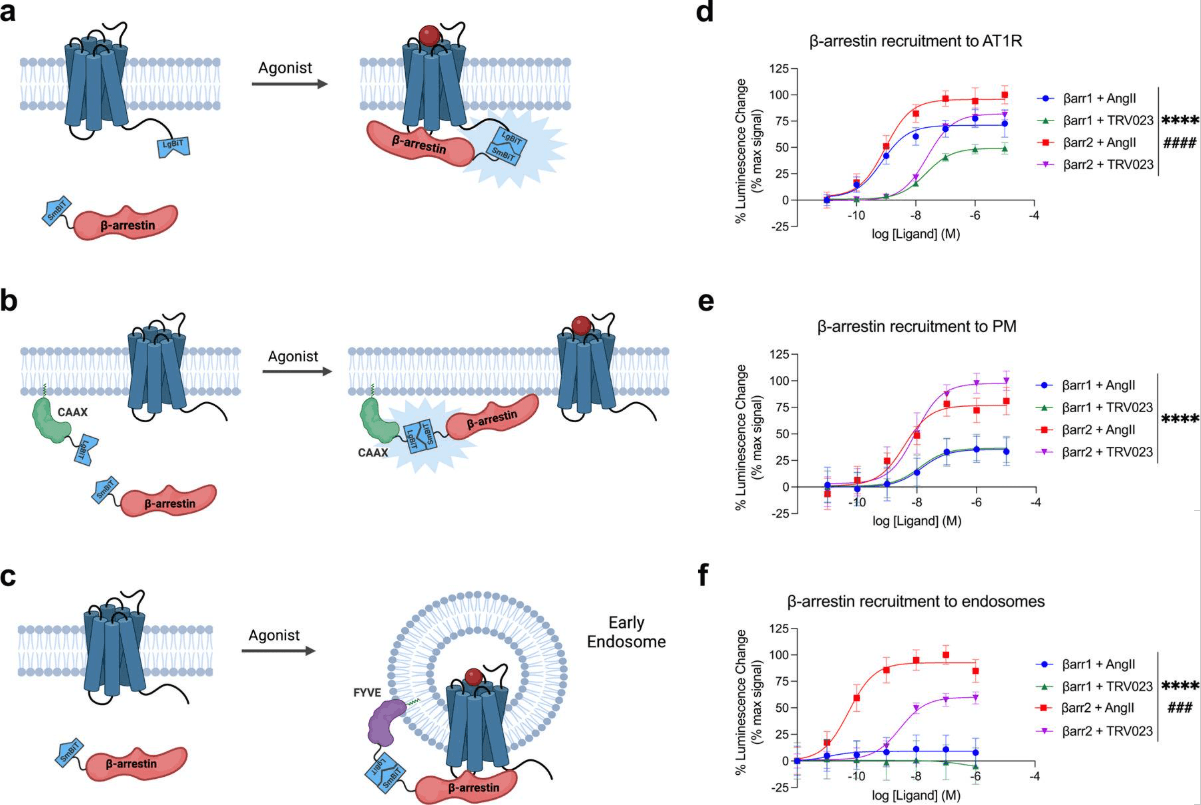
How does signal amnesia show up in product development? Usually late, often after a pharma program has already convinced everyone in the room that it is "working." Oliceridine (TRV130) is a useful example. It was developed as a biased μ-opioid receptor agonist intended to preserve pain relief while reducing respiratory suppression, based on preclinical assays emphasizing G-protein signaling while down-weighting β-arrestin recruitment. In clinical trials, however, its safety and efficacy profile largely converged with conventional opioids. The FDA approved it cautiously in 2020, and commercial uptake reflected the absence of a clearly differentiated clinical benefit. Later analyses highlighted factors underrepresented during optimization, including endogenous opioid competition, signaling kinetics, and context-dependent pathway engagement.
When receptor-level resolution is poorly captured, programs drift toward phenotypic endpoints that work empirically but resist decomposition. This can be effective in narrow contexts, but it limits transfer. Changes in dose, background ligand levels, tissue context, or patient biology routinely produce surprises that were invisible during optimization.
Outside pharma, fragrance turns out to be a particularly unforgiving test of these assumptions. When a large family of GPCRs, the human olfactory receptor (OR) repertoire, was identified, it seemed plausible that mapping odorants to receptors could support bottom-up prediction of odor perception. Olfactory receptors directly transduce chemical stimuli into neural signals, making them an attractive target-centric entry point.
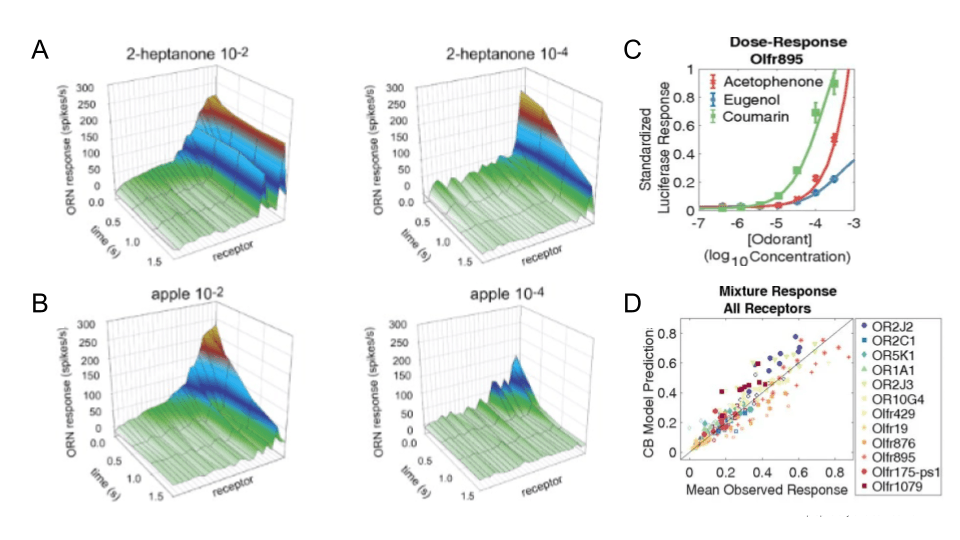
In practice, this approach failed to generalize. Odor perception is encoded combinatorially across hundreds of receptors, and nearly all real-world stimuli are mixtures. Odorants that behave similarly in isolation can distort or invert each other's perceptual effects when combined, due to competitive binding, partial agonism, antagonism, and cooperative effects across receptor ensembles. These make component-wise predictions unreliable [1, 2]. Despite recent improvements in the Fragrance industry, mixture behavior in fragrance is still resolved and validated primarily through human-in-the-loop perception panels, not by preference but by necessity. The biological integration step occurs before any measurement we can directly instrument. The workflow is empirically effective but fundamentally non-programmable. Outcomes can be discovered, but not decomposed. Humans are excellent integrators of high-dimensional sensory input. Systems that depend on humans to resolve internal state, however, are not programmable. They are an inconvenient API.
In the fragrance industry, the failure of receptor-first prediction led not to better receptor assays, but to a shift in what was modeled at all. Givaudan's acquisition of Myrissi in 2019 is illustrative [4]. Myrissi was not a receptor biology company. It modeled human perceptual and emotional responses directly from large sensory datasets, often as embeddings rather than mechanisms.
A natural question follows: if downstream perception can be modeled directly from human data, why does receptor-level resolution matter at all? Why can't perception-trained AI models alone make olfactory biology programmable? The reason is that these models bypass signal resolution entirely. They shortcut directly to the outcome, perception, which sits far downstream of where biological decisions are still structured and controllable. As a result, they cannot predict how changing a single component's concentration will flip a mixture from agonism to suppression, how endogenous ligands reshape responses, or why two formulations converge perceptually and how to systematically separate them. They interpolate within the space of mixtures they have already seen, but they do not extrapolate to new molecules, new receptors, or new competitive regimes without new human data. What they learn is the label. They do not learn the decision surface that produced it.
Making receptor biology programmable means shifting the measurement boundary upstream, to the point where interactions are still competing and states are still reversible. The goal is not to replace phenotypic or perception-level models, but to give them constraints that generalize. That requires measuring receptors under competition, across concentrations, and in context, rather than as isolated ligand–receptor pairs. Some of the missing context has become measurable, still only in fragments. For temporal receptor signaling, recent work has started to read out cAMP and β-arrestin recruitment simultaneously and kinetically in the same well, moving beyond "one endpoint per ligand" characterization [5]. For context dependence, platforms like ONE-GO make it possible to measure GPCR G-protein activation with high fidelity even when receptors are endogenously expressed, allowing signaling to be compared across cell types rather than assumed to be conserved [6]. For signaling competition, multicolored sequential resonance energy transfer can detect simultaneous binding of multiple ligands at the same GPCR, which is the kind of measurement required if mixtures and endogenous ligands are going to be treated as first-class inputs rather than nuisance variables [7]. And for signaling scale, deep receptor scanning efforts are beginning to generate parallel functional profiles across hundreds of GPCRs, exposing just how much structure has been collapsed by traditional assays [8].
Making receptors programmable in practice means pulling these richer measurements into real product workflows, early enough to sharpen product design decisions in Pharmacology, Fragrance and other industries that depend on receptor modulation to control cellular, tissue-level and perceptual responses. With orthogonal measurements in place, models can move beyond fitting endpoints and start learning how receptor systems resolve competition, context, and time. That shift is what moves sensory biology from tuning trial-and-error outcomes to designing behavior.
References
- [1]Competitive binding predicts nonlinear responses of olfactory receptors to complex mixtures
- [2]Coding of Odors by a Receptor Repertoire
- [3]Location-biased β-arrestin conformations direct GPCR signaling
- [4]Givaudan to acquire Myrissi
- [5]Kinetic multiplex assay to assess biased signaling of clinical GPCR agonists
- [6]Direct interrogation of context-dependent GPCR activity with a universal biosensor platform
- [7]Multicolored sequential resonance energy transfer for detection of simultaneous ligand binding at G protein-coupled receptors
- [8]Deep Receptor Scanning Reveals General Sequence Constraints on GPCR Biosynthesis